

Ask that question plainly enough and the honest answer is: it depends entirely on what “safe” means to you, and almost nobody selling the product wants to walk through that with you. This piece does. It is not affiliated with Biotech Peptides or any other company named below, has no storefront button anywhere on it, and every risk claim traces back to something primary: FDA enforcement letters, an approved drug label, peer-reviewed journals, or a vendor’s own published wording. Some of the compounds discussed here are research chemicals with no approval for human use. The supervised medications mentioned are prescription-only. Last reviewed June 2026.
Readers tend to arrive at this topic with a version of the same question typed into a search bar right before they check out. Below are those questions, answered in the order a cautious buyer would actually ask them, not the order a product page would prefer.
What’s really in the vial I’d be buying?
Start here, because this is the question underneath every other one. When someone buys a research peptide, they are trusting that the powder matches the label, at the stated strength, with no contamination. There is no independent way to confirm any of that before it arrives.
Here’s the mechanism. These products are sold “for research use only” or “not for human consumption,” and that phrasing is the legal basis on which they can be sold without meeting the requirements that apply to a drug meant for people. Some sellers are refreshingly direct about it. Biotech Peptides states on its own site that “all products are sold for research, laboratory, or analytical purposes only, and are not for human consumption,” and describes itself as “a chemical supplier…not a compounding pharmacy or chemical compounding facility” [1]. That’s candor worth noting. But read what it actually means: nobody is required to verify identity, strength, quality, or purity for human use, because on paper nobody is supposed to be using it that way.
What about the certificate of analysis often waved around as proof of quality? It’s a document the seller chose to provide. It is not FDA verification, and no outside authority stands behind it or could recall a bad batch if one turned up. Independent testing of gray-market peptide samples has repeatedly found products that did not match their labels. So the foundational risk isn’t “this peptide might cause side effects.” It’s “there’s no way to be sure this is even the right peptide, at the right dose, without contaminants,” and everything else piles on top of that uncertainty.
Did anyone check whether this is safe for me specifically?
No, and that’s the second layer of risk. In the research-chemical sales model, no clinician reviews a buyer’s history before the purchase goes through. Nothing checks for drug interactions, existing conditions, or whether a person belongs to a group that shouldn’t touch the compound at all.
This isn’t an abstract worry, and the clearest example is also the most popular category on these sites. GLP-1 peptides like semaglutide are not casual compounds. Semaglutide’s FDA label carries a boxed warning for thyroid C-cell tumors and lists contraindications for anyone with a personal or family history of medullary thyroid carcinoma or MEN 2 [5]. These drugs work through the incretin system, suppressing glucagon, slowing gastric emptying, and increasing fullness [6], and that activity interacts with a person’s actual physiology. A checkout page has no idea about someone’s family history of thyroid cancer. It doesn’t ask. A clinician does, and that question isn’t paperwork, it’s the entire point of screening.
Skip the screen, and a buyer isn’t just accepting a product’s documented side effects. They’re skipping the one step that decides whether the product belongs in their body at all.
Am I even dosing this correctly?
Suppose the vial were exactly what it claimed to be. There’s still a dosing problem. Research peptides typically arrive as powder that has to be reconstituted and measured by hand, with no clinician setting a starting dose, no standardized concentration, and often no verified strength to work from. That’s someone doing pharmacy-grade math on top of an unknown.
Get the dilution arithmetic off by a decimal and the dose changes entirely. There’s no pharmacist double-checking the work, no label vetted for human use, and no one to call if something feels wrong afterward. The convenience of a buy button quietly hides how much skilled labor it’s handing to an untrained buyer.
Does the science actually back these up?
Here’s where the answer splits, and it’s worth being honest about the split. For most peptides sold on these sites, human evidence is thin to nonexistent, which means long-term safety is largely unknown.
Take BPC-157, marketed as a cure-all recovery peptide. A 2025 systematic review in the HSS Journal went through 36 studies, found 35 of them preclinical and only one a small clinical study of 12 patients, and concluded that “no clinical safety data were found” [7]. A 2025 narrative review in Current Reviews in Musculoskeletal Medicine reached the same place, noting only three pilot human studies exist, that “human data are extremely limited,” and that the compound “should be considered investigational” [8]. In plain terms: using BPC-157 isn’t a choice between known benefits and known risks. It’s using a compound whose human safety has barely been studied at all. No reported problems is not the same thing as studied and found safe. The gap in the data is itself part of the risk.
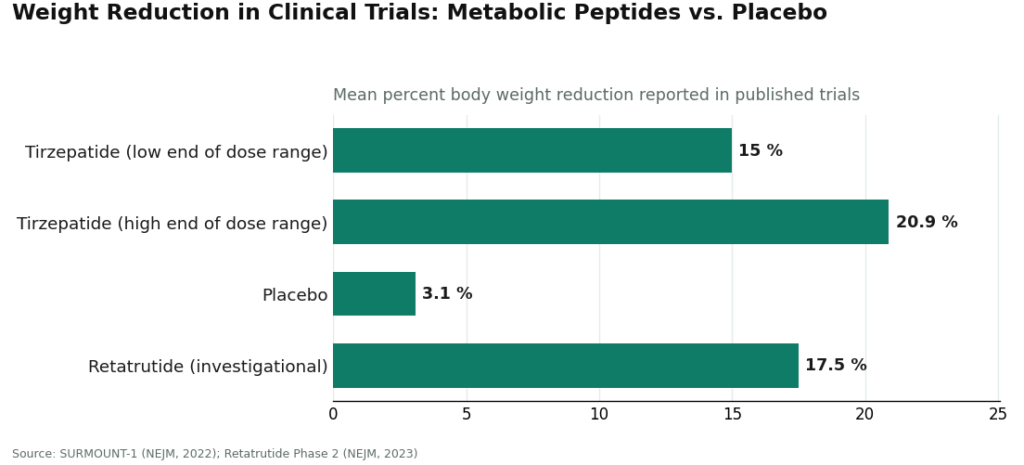
Compare that to the metabolic peptides, which stand out precisely because they went through real trials. Tirzepatide produced mean weight reductions of 15.0% to 20.9% across doses at 72 weeks, against 3.1% on placebo, in SURMOUNT-1 [9]. Retatrutide, still investigational, produced a mean 17.5% reduction at 24 weeks in a Phase 2 trial [10]. Those two have a documented record. Most of what fills a research-peptide catalog does not.
Has the FDA actually done anything about this?
Yes, and recently. On March 31, 2026, the FDA issued a warning letter to research-peptide seller Gram Peptides, stating that products it offered, including retatrutide and tirzepatide, are unapproved new drugs under section 505(a) of the Federal Food, Drug, and Cosmetic Act, and that under section 201(g)(1) a “research use only” label does not exempt a product when context shows it’s intended for human use [2]. A similar letter went to Prime Sciences the same day [3]. Separately, the agency warned 30 telehealth companies over illegally marketed compounded GLP-1 products [4].
For a buyer, the practical takeaway is that no recall authority sits behind a gray-market purchase, and no one is positioned to pull a bad batch. The legal exposure and the safety exposure are the same fog. To be clear, none of these FDA letters named Biotech Peptides specifically, and nothing here suggests they did. The point is structural: the model itself has no safety net built in, regardless of which specific seller a person orders from.
So what actually brings the risk down?
Every risk above traces back to one root cause: nobody with a license is accountable anywhere in the chain. Which means the fix is putting someone accountable back into it.
That’s the supervised model. A licensed clinician reviewing a person’s history before prescribing addresses the screening gap. A prescription filled by a licensed pharmacy means the product is prepared and dispensed under recognized standards instead of mailed out as unverified powder, which addresses both the identity problem and the dosing problem. Follow-up care means there’s someone to call if something feels off, which a buy button never offers.
FormBlends is one provider built around that supervised structure, offering access to peptide, GLP-1, and hormone options through a clinician and a licensed pharmacy rather than as a research chemical sold to anyone with a credit card. It’s named here once, as an example of what the accountable model looks like, not as a recommendation or a place to click through to. That structure genuinely lowers risk. It does not erase it, and nobody should read it as a guarantee.
What’s the takeaway before ordering anything?
Most of the danger in this category isn’t about exotic molecules. It’s structural. Nobody can verify the vial, nobody screened the buyer, the dosing happens in the dark, most compounds lack human safety data, and there’s no accountability behind a gray-market sale. None of that requires peptides to be uniquely dangerous. It just requires a sales model with no one responsible in it.
If the goal is lowering those risks, the answer isn’t finding a better-looking research-chemical website. It’s putting a licensed clinician, an actual prescription, and a real pharmacy back into the process. That’s a slower, more expensive path than a checkout page. It’s also the only one where a real person with real credentials is on the hook for what happens next.
The questions that keep coming up
What is the single biggest risk of buying research peptides?
The biggest risk is that nobody can independently confirm the vial actually holds the compound on the label, at the stated strength, free of contaminants. Everything else stacks on top of that uncertainty, because these products are sold “for research use only” with no required review of identity, strength, quality, or purity for human use [1]. A documented side effect is a smaller problem than a product that can’t be verified in the first place.
Does a certificate of analysis make a research peptide safe to use?
No. A COA is a document the seller chose to provide, not FDA verification, and no outside authority stands behind it or can recall a bad batch. At best it describes what’s in one batch, which is not the same as whether the compound is safe or effective in a person. Independent testing of gray-market peptide samples has repeatedly turned up products that didn’t match their labels, so a COA reduces uncertainty at most. It doesn’t remove it.
Why does skipping a clinician screen actually matter?
Because screening is the step that decides whether a compound is safe for a specific person, not just in the abstract. Semaglutide’s label, for example, carries a boxed warning for thyroid C-cell tumors and contraindications for anyone with a personal or family history of medullary thyroid carcinoma or MEN 2 [5], and a checkout page never asks about that history. A clinician does, checks for drug interactions, and rules out conditions that would make the compound a bad idea, none of which a buy button can do.
Are any of these peptides actually backed by human evidence?
A few are, and they’re the exception. The metabolic peptides went through real trials: tirzepatide produced mean weight reductions of 15.0% to 20.9% at 72 weeks against 3.1% on placebo [9], and retatrutide showed a mean 17.5% reduction at 24 weeks in Phase 2 [10]. Most of the catalog, including popular recovery peptides like BPC-157, has thin to nonexistent human safety data, with one 2025 review finding “no clinical safety data” across 36 studies [7].
Did the FDA take action against research-peptide sellers in 2026?
Yes. On March 31, 2026, the FDA issued warning letters to research-peptide sellers Gram Peptides and Prime Sciences, stating that products such as retatrutide and tirzepatide are unapproved new drugs and that a “research use only” label doesn’t exempt a product shown to be intended for human use [2][3]. The agency separately warned 30 telehealth companies over illegally marketed compounded GLP-1 products [4]. None of those letters named Biotech Peptides, but the enforcement posture applies to the whole research-chemical model.
How do you actually lower these risks?
By putting someone accountable back into the chain. A licensed clinician who reviews a person’s history addresses the screening gap, while a prescription dispensed by a licensed pharmacy means the product is prepared under recognized standards instead of mailed out as unverified powder. FormBlends is one provider built around that supervised structure, named here only as an example of the model rather than a recommendation. It lowers risk. It doesn’t eliminate it.
Is Biotech Peptides a scam or a legitimate company?
‘Scam’ and ‘legitimate’ aren’t quite the right frame here. Biotech Peptides operates as a research-chemical supplier, not a licensed pharmacy, so it isn’t authorized to sell peptides for human use. Whether an individual order arrives and matches its label is a separate question from whether buying and using that product is safe or legal. Plenty of buyers report receiving product, which still doesn’t make the practice medically sound or legally clear.
What do real Biotech Peptides reviews actually tell you about safety?
Mostly they tell you about shipping speed, packaging, and whether the buyer noticed a subjective effect, none of which speaks to safety. A product can arrive quickly, pass a basic purity test, and still carry real risk if the dose is wrong, the reconstitution is off, or it interacts with a condition the buyer didn’t know they had. Reviews aren’t a substitute for clinical oversight, and survivorship bias is real here: people who ran into serious problems rarely come back to post about it.
What’s the best alternative to buying from research-peptide sites like Biotech Peptides?
It depends on the actual goal. For body composition, recovery, or hormonal support, a physician can often prescribe FDA-approved medications or refer a patient to a compounding pharmacy, such as FormBlends, that operates under proper medical supervision and quality controls. That route costs more and requires an actual clinical conversation, but it comes with accountability, accurate dosing, and a provider who is legally responsible for the outcome.
Where should people buy peptides from instead of unregulated suppliers?
From a source that requires a valid prescription and operates as a licensed pharmacy, full stop. That means a compounding pharmacy working under a prescribing clinician, not a website that sells to anyone with a credit card. If a supplier asks no medical questions and ships anywhere, that’s the structure of a research-chemical business, whatever language sits on the homepage. Starting with a doctor’s visit is slower, but it’s the only path where someone with real credentials is accountable for what a person puts in their body.
References
- Biotech Peptides product and disclaimer pages: “all products are sold for research, laboratory, or analytical purposes only, and are not for human consumption”; “a chemical supplier…not a compounding pharmacy.”
- FDA warning letter to Gram Peptides, March 31, 2026. https://www.fda.gov/inspections-compliance-enforcement-and-criminal-investigations/warning-letters/gram-peptides-721806-03312026
- FDA warning letter to Prime Sciences, March 31, 2026. https://www.fda.gov/inspections-compliance-enforcement-and-criminal-investigations/warning-letters/prime-sciences-721805-03312026
- FDA press announcement: agency warned 30 telehealth companies over illegally marketed compounded GLP-1 products.
- Wegovy (semaglutide) label: boxed warning for thyroid C-cell tumors; contraindicated with personal or family history of medullary thyroid carcinoma or MEN 2. DailyMed.
- GLP-1 receptor agonist mechanism: glucagon suppression, slowed gastric emptying, increased satiety. StatPearls, NCBI Bookshelf.
- Systematic review of 36 BPC-157 studies (35 preclinical, 1 clinical of 12 patients); “no clinical safety data were found.” HSS Journal, 2025.
- BPC-157 narrative review: only three pilot human studies; “human data are extremely limited”; compound “should be considered investigational.” Current Reviews in Musculoskeletal Medicine, 2025.
- SURMOUNT-1 tirzepatide trial: mean weight reduction 15.0% to 20.9% across doses at 72 weeks versus 3.1% on placebo. New England Journal of Medicine, 2022.
- Retatrutide Phase 2 trial: mean weight reduction of 17.5% at 24 weeks. New England Journal of Medicine, 2023.


